Continuous Fourier Transform (non-periodic, continuous-time)
If you take the Fourier series and let the period , the discrete harmonic lines become continuous — resulting in the Continuous Fourier Transform (CFT). It represents general, non-periodic continuous-time signals.
CFT for a continuous sequence
Inverse CFT for a continuous sequence
- The CFT assumes a continuous-time signal defined for all .
- Not directly computable on a digital computer because it requires infinite, continuous data.
- The forward and inverse transforms differ in the sign of the complex exponential (which determines rotation direction) and—in discrete implementations—by a normalization factor (e.g. for the inverse DFT in the engineering convention). Both differences are required so the inverse undoes the forward transform.
Example: Gaussian pulse
A Gaussian pulse is a common non-periodic signal. Its CFT is also a Gaussian (frequency-domain spread inversely proportional to time-domain width). Note how the time-domain Gaussian width inversely affects the spread in the frequency domain in Figure 1.
In practice, we compute approximate transforms digitally using the DFT/FFT, which discretizes both time and frequency.
Figure 1: Gaussian pulse in time domain (top) and magnitude of its CFT (bottom)
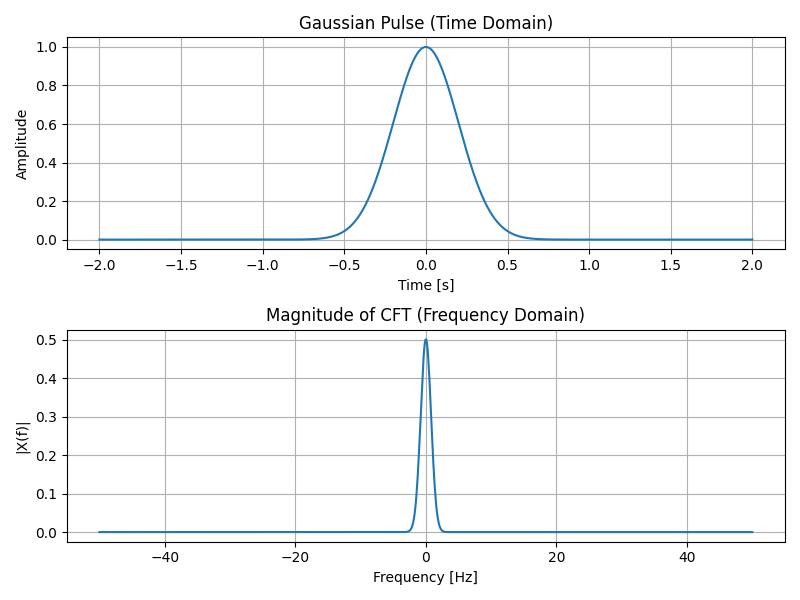
In previous sections, frequency-domain graphs showed the magnitude on the y-axis. Here, |X(f)| represents the same concept: the amplitude of each frequency component.
is the same as what we referred to as "magnitude" in the previous sections.
View Figure 1's code
import numpy as np
import matplotlib.pyplot as plt

# Time vector
t = np.linspace(-2, 2, 1000)

# Gaussian pulse
sigma = 0.2
x_t = np.exp(-t**2 / (2*sigma**2))

# Frequency vector for plotting
f = np.linspace(-50, 50, 1000)

# Continuous Fourier Transform (analytical for Gaussian)
X_f = sigma * np.sqrt(2*np.pi) * np.exp(- (2*np.pi*f*sigma)**2 / 2)

# Plot
fig, axs = plt.subplots(2, 1, figsize=(8,6))

# Time domain
axs[0].plot(t, x_t)
axs[0].set_title("Gaussian Pulse (Time Domain)")
axs[0].set_xlabel("Time [s]")
axs[0].set_ylabel("Amplitude")
axs[0].grid(True)

# Frequency domain (magnitude)
axs[1].plot(f, np.abs(X_f))
axs[1].set_title("Magnitude of CFT (Frequency Domain)")
axs[1].set_xlabel("Frequency [Hz]")
axs[1].set_ylabel("|X(f)|")
axs[1].grid(True)

plt.tight_layout()
plt.show()